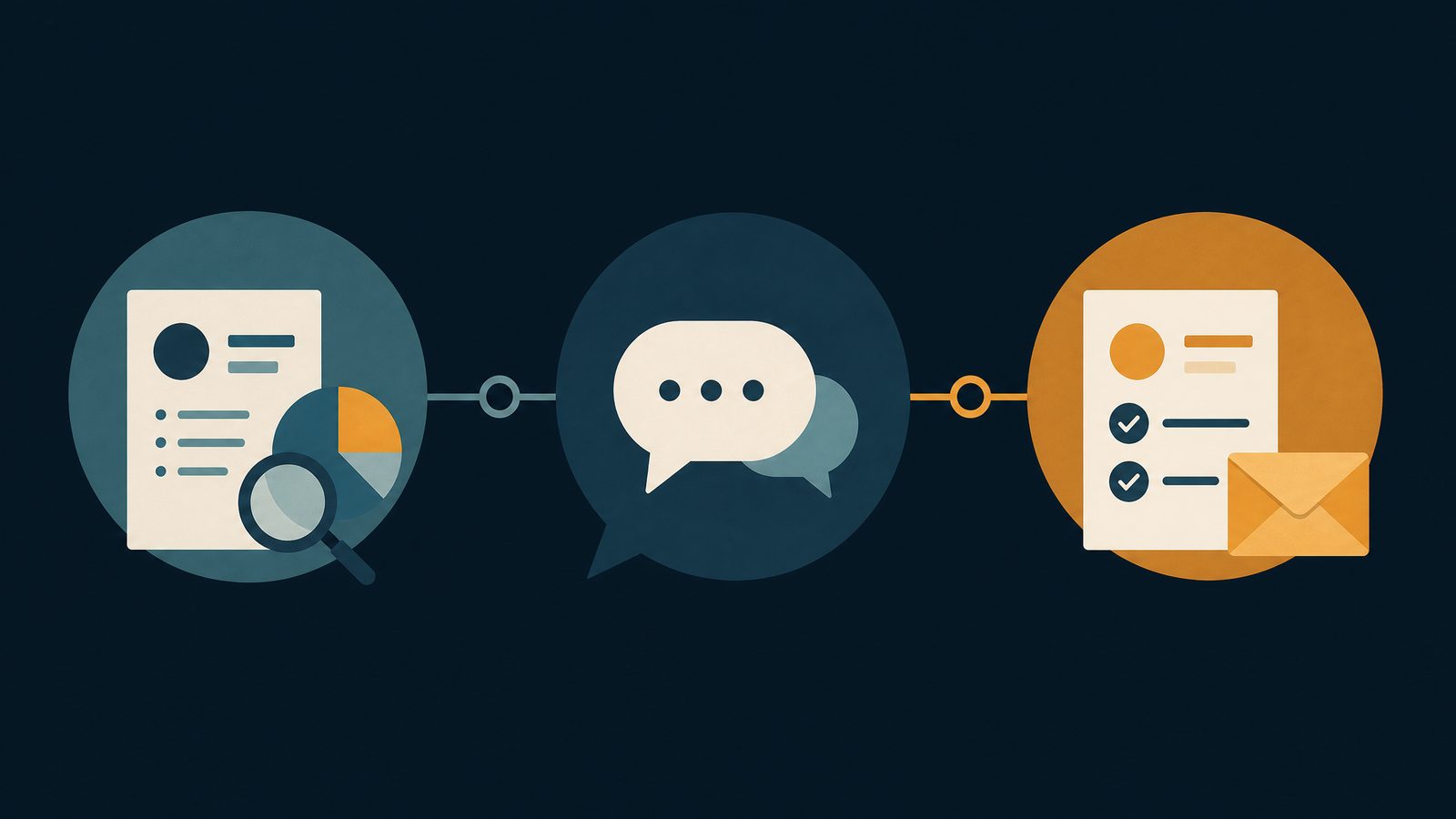
If you want to know how to make a sales call, stop thinking about the call as the thing you do and start thinking about it as the middle of three things. Before the call you do the research and decide what outcome you are after. During the call you earn the right to ask good questions, you ask them, and you get agreement on a specific next step. After the call you recap what you heard in the buyer's words and you do what you said you would do. Skip the before and the after and you are not making a sales call, you are making noise.
TL;DR: A sales call is three jobs, not one. The research and the plan you build before you dial decide whether the conversation is worth the buyer's time, the call itself is about earning the right to ask real questions and getting agreement on what happens next, and the follow-up is where most deals quietly die. Run all three and you are already better than most of the people competing with you.
What is a sales call actually for?
A sales call is not a pitch with a question mark at the end. The purpose is to find out whether there is a real business problem worth solving, whether you are the right person to solve it, and whether now is the right time. That is it. If the answer to any of those is no, the most valuable thing you can do is find that out fast and stop spending each other's time.
Most reps treat the call as a performance. They rehearse what they want to say instead of what they need to learn, and then they wonder why the buyer goes quiet afterward. The reps who win treat the call as an investigation where the buyer does most of the talking and leaves knowing something they did not know before they picked up.
This is where AI changes the bar. Buyers now show up having already done a chunk of their own research, so the call where you read your company's value prop out loud has no reason to exist. AI doesn't replace great salespeople, it exposes the gap between average and great, and nowhere is that gap more visible than on a live call.
What do you do before a sales call?
Preparation is where the call is won or lost. You are not trying to learn everything about the company, you are trying to find the one or two things that make this conversation worth having right now, and then building a plan around them.
Here is the work that actually matters before you dial:
- Know who you are talking to and what that role is measured on. A VP of Sales and a VP of Finance care about completely different outcomes from the same purchase.
- Find the trigger. Something changed at that company, a hire, a funding round, a new product, an earnings comment, a reorg. If you cannot find a reason why now, your call has no urgency built into it.
- Write down the one business problem you believe they have and the evidence you have for believing it. If you cannot write it, you are not ready.
- Prepare three to five questions you genuinely do not know the answer to. Not questions designed to lead them somewhere, questions you actually want answered.
- Decide the ideal next step before the call starts. Know what a good outcome looks like so you are not improvising at minute twenty-eight.
- Use AI to compress the research, not to replace the thinking. It can pull the 10-K language, the job postings, the recent announcements. You still have to decide what any of it means for this buyer.
How do you run the call itself?
Open by setting the agenda and asking the buyer what they want to get out of the time. That one move changes the dynamic from interrogation to conversation and it gives you permission to steer.
Then earn the right to ask hard questions. You earn it by showing you did the work, by referencing something specific about their business that proves you are not reading from a script, and by being clear about why you reached out to them specifically. Once you have that, you can ask the questions that make a difference.
Ask about the problem, the impact, and what happens if nothing changes. A lot of reps get the problem and stop there. The impact is what justifies a budget and the cost of doing nothing is what creates urgency. If the buyer cannot articulate what the problem is costing them, you do not have a deal, you have an interesting chat.
A question I think every rep should be asking right now is what the buyer has already learned from AI about their problem, and what they still need to validate before they can make a decision. Buyers are doing their homework without us. Find out what they found, then add the thing AI could not give them.
What do you do after a sales call?
The follow-up is not an administrative task. It is the proof that you listened, and it is the single easiest place to separate yourself from everybody else in the deal.
Send the recap within a few hours while it is fresh. Use the buyer's language, not your marketing language. Restate the problem they described, the impact they put on it, the next step you agreed on, and the date. If they used a specific number or a specific phrase for what is broken, put it in there exactly as they said it.
Then do what you said you would do, when you said you would do it. That is the whole game on follow-through. Reps lose deals every day not because their product lost but because they said they would send something by Thursday and sent it the following Tuesday with an apology.
Last, update the CRM honestly. Write down what you actually learned, including what you did not learn. A pipeline built on optimistic notes is a forecast problem waiting to happen.
What are the most common mistakes reps make on sales calls?
Almost all of them come from the same root cause, which is the rep making the call about themselves instead of the buyer. Here are the ones I see constantly:
- Pitching before you understand the problem, usually because the rep is more comfortable talking than listening.
- Asking questions you could have answered yourself with ten minutes of research. That is the fastest way to lose credibility.
- Accepting the first answer. The first answer is almost never the real answer. Follow up on it.
- Ending the call with "I'll follow up next week" instead of a specific date, time and purpose on both calendars.
- Talking too much. If you are talking more than the buyer on a discovery call, it was not a discovery call.
- Treating every call the same. A first call, a technical deep dive and a close call are different conversations with different objectives.
How do you know if a sales call went well?
The answer is not how good the conversation felt. Plenty of friendly calls go nowhere. Judge it against these:
Did the buyer tell you something you could not have found in your research? Did they put an impact on the problem, in their terms? Did you both agree on a specific next step with a date, and did anyone else need to be in that next conversation? Can you write a recap email that uses their words and would make sense to their boss if they forwarded it?
If you cannot answer yes to most of that, the call did not go well, no matter how much you liked each other. Honest self-assessment here is also what makes coaching work, because a rep who can tell you why a call fell short is a rep you can actually develop.
The JB Sales Approach
Everything I teach comes back to one idea, which is that sales is a science. The parts of a sales call that feel like art are repeatable once you break them into steps you can run, measure and coach. That is the basis of both Filling the Funnel and Driving to Close.
Filling the Funnel handles the before: who you target, why now, the trigger event, the research and the outreach that earns the call. Driving to Close handles the during and the after: discovery that surfaces the business problem and its impact, objection handling, and controlling next steps so deals do not stall.
Both programs include AI application layers so reps learn the fundamentals and the tools together, in the right order. Teach the tools first and you have given a rep a faster way to make bad calls. Teach the fundamentals first and AI becomes a force multiplier.
- Before: trigger, research, hypothesis, questions, desired next step.
- During: agenda, earn the right, problem, impact, cost of inaction, agreed next step.
- After: same-day recap in the buyer's words, do what you said, honest CRM notes.
What to do this week
Pick your next five calls and do one thing differently on each of them. Before the call, write down in a single sentence the business problem you believe that buyer has and the evidence for it. If you cannot write the sentence, you are not ready to dial and you should go back and do the research.
Then record those calls and listen to two of them. Count how much of the time you were talking. If it is more than half on a first call, that is your fix for the month. After each one, send the recap within three hours using their words and a specific next step with a date on both calendars.
If you do that for five calls and the pattern you see is a process problem across the whole team rather than one rep, that is a bigger conversation. JB Sales Advisory is a 3-month strategic engagement that starts with a written diagnostic of your sales motion, AI readiness, and team structure, and ends with a 90-day plan you can execute: learn.jbarrows.com/pages/advisory. For team training, Filling the Funnel and Driving to Close integrate AI into a fundamentals-first workflow at learn.jbarrows.com/pages/team-training-packages. For individual sellers, JB Sales Elite is a 3-month engagement with weekly 1:1 coaching, a custom sales plan, and direct access to me, and JB Sales Pro gives on-demand access to the full training library, live sessions, and group coaching at learn.jbarrows.com/pages/individual-packages.
Frequently asked questions
How do you start a sales call without sounding like every other rep?
Set the agenda, say specifically why you reached out to this person at this company, and then ask them what they want to get out of the time. The specificity is what separates you, because it proves you did the research instead of running a template.
How long should a sales call be?
Long enough to understand the problem and its impact and to agree on a next step, and no longer. If you booked thirty minutes and you have what you need at twenty, give the buyer the ten minutes back. They will remember it.
What questions should I ask on a sales call?
Ask about the problem, what it is costing them, and what happens if they do nothing. Then ask what they have already learned from AI about the problem and what they still need to validate before they can make a decision. That last one tells you exactly where you add value.
Can AI make sales calls for me?
AI can do a lot of the preparation and almost all of the research grunt work, and it can help you clean up a recap email. It cannot read a hesitation in someone's voice, it cannot push back on a bad assumption in the moment, and it cannot build trust. AI doesn't replace great salespeople, it exposes the gap between average and great.
My reps are bad on calls. Should I replace them or retrain them?
Listen to ten calls before you decide. If reps have never been taught the before and the after, and most have not, that is a training gap rather than a talent gap, and retraining is faster and cheaper than replacing. The full replace, rebuild, or retrain framework is at learn.jbarrows.com/pages/replace-or-rebuild.